



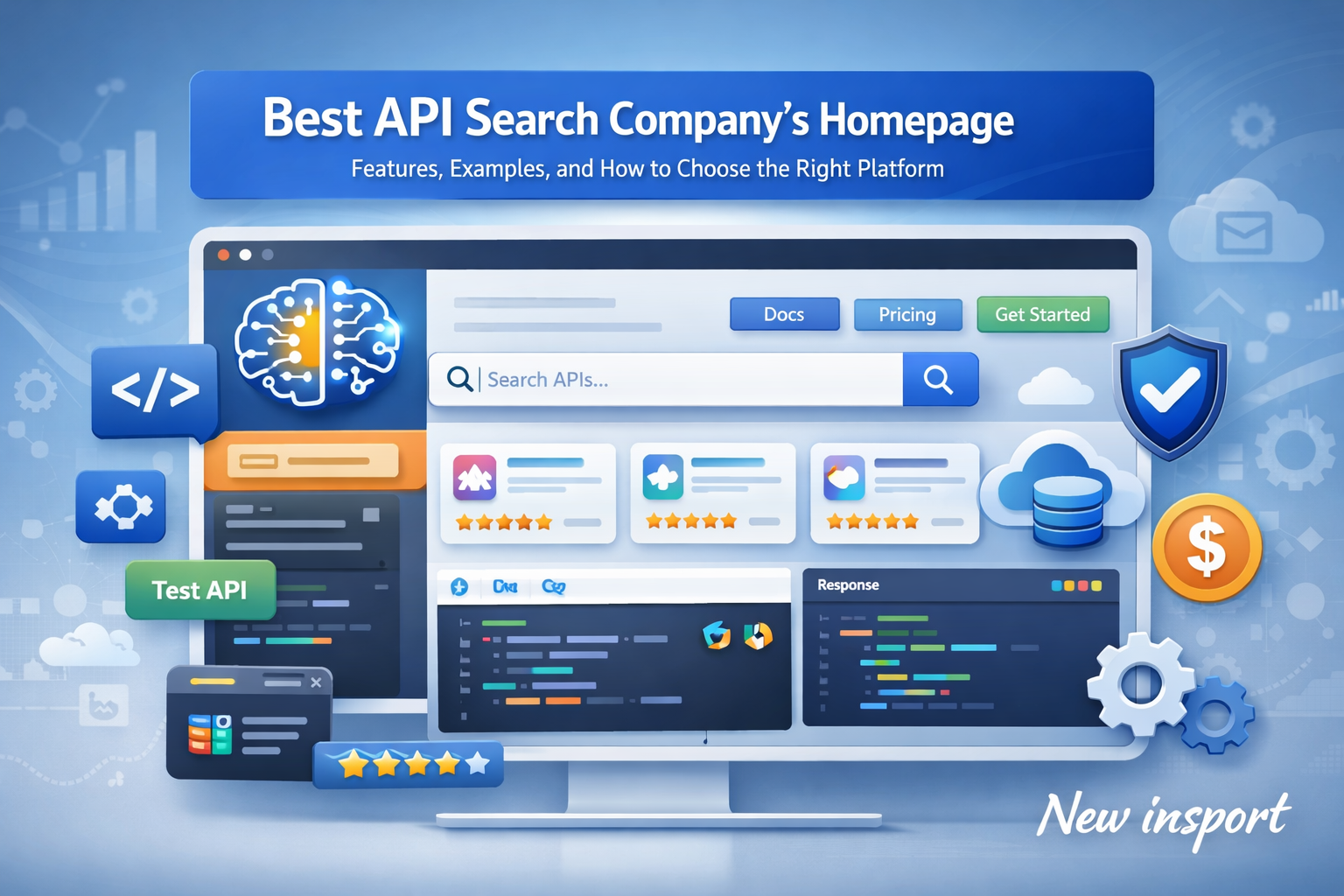
When people search for the best API search company’s homepage, they are usually looking for more than a nice-looking website. They want a homepage that helps them discover APIs quickly, understand what each API does, test endpoints without friction, compare pricing, review documentation, and decide whether a platform is worth trusting.
That is where many articles on this topic fall short. They talk about design in broad terms, but they rarely explain what separates a homepage that merely looks polished from one that actually helps developers move faster. The best API search company homepages do both: they create a strong first impression and reduce the time between “I found this platform” and “I can use this API in my product.” The competing articles you shared all circle around the same ideas, especially discovery, developer experience, testing, documentation, integrations, and trust.
In this guide, we will break down exactly what makes a homepage effective, what developers expect to see, which examples stand out, and how to evaluate a platform before you commit engineering time or budget.
What Is an API Search Company’s Homepage?
An API search company’s homepage is the front door to a platform that helps users find, evaluate, and use APIs. Depending on the company, that homepage may lead to an API marketplace, a search API product, a data extraction API, or an enterprise-grade search platform. Its job is to communicate value fast, reduce confusion, and guide visitors toward the next action, whether that is browsing APIs, reading documentation, creating an API key, or trying a live demo.
For developers, the homepage is often the first quality signal. If the navigation is confusing, pricing is hidden, documentation is hard to find, or the product positioning is vague, trust drops immediately. On the other hand, when a homepage clearly explains the product, links directly to docs, shows code examples, and makes testing easy, it reduces friction and increases adoption. That is why the homepage matters not only for branding, but also for conversion and retention.
A strong homepage also affects API discovery. In practice, users are not just asking, “Does this platform have APIs?” They are asking, “Can I find the right API fast, understand it fast, and trust it fast?” The best homepages answer all three questions within seconds.
Why the Best API Search Company’s Homepage Matters
A good homepage shortens the path to value. Instead of making users dig through menus or marketing language, it shows what the platform does, who it is for, and how to get started. That matters because developers tend to judge tools quickly. If the first experience feels slow, vague, or overcomplicated, they move on.
The best API homepages improve the speed of discovery. Search filters, categories, featured APIs, and strong internal search help users find relevant tools faster. This is especially important in marketplaces and multi-product platforms, where choice overload can become a real problem.
They also improve the developer experience. Algolia, for example, emphasises fast search performance and states that most of its search queries take 1 to 20 milliseconds, while its support guidance says teams should aim for end-user search response times below 100 ms for an optimal experience. Those numbers matter because performance is not an abstract feature; it directly affects perceived product quality.
Finally, the homepage influences trust. Brave highlights that its Search API uses its own web index at scale and includes $5 in free monthly credits, which immediately helps visitors understand both differentiation and entry cost. Transparent details like these reduce uncertainty and support decision-making.
Key Features of the Best API Search Company’s Homepage
Clear value proposition
The first thing a homepage needs is clarity. A developer should understand the product at a glance. Is it an API marketplace? A site search API? A web search API? A company homepage data API? If the visitor has to guess, the homepage is underperforming. Brave does this well by positioning itself as a search API with its own independent web index. Elastic also clearly frames its search capabilities around search-powered applications, query methods, ranking, and data ingestion.
Simple navigation and smart search functionality
A strong homepage makes discovery effortless. Users should be able to browse by category, search by use case, and filter by relevance, pricing, popularity, or technical fit. This is especially important on large marketplaces, where the real challenge is not availability but findability. RapidAPI has long been positioned as a large API marketplace, which makes search and categorisation central to the homepage experience. A 2024 ACM paper described RapidAPI as the largest API marketplace and reported that it offered over 40,000 APIs used by more than 4 million developers at the time of publication.
API categories and filters
Categories help users navigate without knowing exact product names. For example, someone might search for “SEO API,” “company data API,” “SERP API,” or “site search API” rather than a specific vendor. Good category design supports both beginner discovery and expert comparison.
Developer-friendly documentation access
The best homepages do not bury docs in the footer. They surface documentation early because docs are part of the product, not an afterthought. Elastic’s documentation structure is a good example of this mindset: it makes API docs, client libraries, query languages, and solution paths easy to reach from the main documentation hub.
Live API testing or interactive demos
A modern API homepage should let users try something before commitment. That could be an interactive playground, a sample search box, a response preview, or an endpoint tester. Testing reduces risk because developers can see the output format, latency, and likely integration effort before signing up for a paid plan.
Code examples and SDK libraries
Code samples reduce friction faster than marketing copy ever can. Users want to know: What does the request look like? Which languages are supported? How fast can I prototype? Elastic explicitly highlights client libraries across multiple languages, while many API platforms surface starter requests directly on product pages.
Easy API key access
The moment a developer decides to try a platform, key generation should be simple. Delays here kill momentum. One-click or low-friction sign-up is often a conversion advantage, especially in self-serve products.
Transparent pricing
Pricing visibility matters more than many companies think. Hidden pricing can signal enterprise complexity, slow procurement, or future surprises. Brave’s public pricing pages are a good example of transparency: it shows free monthly credits and usage-based plan details on its Search API pages.
Security and compliance information
Security is not a secondary concern for API buyers. Teams need confidence around authentication, privacy, abuse prevention, and platform reliability. Brave emphasizes privacy in its Search API messaging, while enterprise-oriented platforms often surface security, governance, or deployment information early in the buying journey.
Ratings, reviews, and trust signals
Trust can be built with customer logos, testimonials, uptime data, usage numbers, or independent credibility signals. These help users feel they are not taking a blind risk.
What Developers Expect From a Great API Homepage
Developers expect speed, clarity, and proof. That starts with fast page load and a clean interface, but it goes deeper. They want immediate links to docs, quick insight into authentication, supported languages, pricing, rate limits, and realistic examples. When that information is missing, it signals that the integration journey may be harder than the homepage suggests.
They also expect onboarding help. This includes quickstarts, tutorials, SDK references, FAQs, and support channels. Elastic’s docs emphasize getting started, deployment choices, ingestion methods, and query options, which is exactly the kind of path new users need. Platforms that combine education with product access tend to convert better because they reduce uncertainty step by step.
Another expectation is visible product performance. In search and API tools, performance is not just a technical metric; it is part of the buying decision. Algolia’s published guidance around millisecond-level response times and sub-100 ms user experience targets is powerful because it gives prospects a concrete benchmark, not just a vague promise of speed.
Types of API Search Company Homepages
Not every API search homepage serves the same user intent. To choose the right platform, you need to understand the category first.
API discovery platforms
These platforms help users browse and compare many APIs in one place. Their homepage should emphasize search, categories, popularity, reviews, and easy testing. RapidAPI is the clearest example of this model. It has historically been positioned as a large marketplace for discovering and connecting to APIs through a single account and shared tooling.
Search engine APIs
These products provide developers with access to search capabilities or web search results via an API. Brave Search API fits here because it promotes access to web search backed by its own independent index. Its homepage positioning is particularly relevant for AI and search application builders.
Company homepage data APIs
These APIs are designed to extract structured information from company websites or homepages. This use case matters for sales intelligence, SEO monitoring, market research, pricing tracking, and competitive analysis. A homepage in this category should clearly explain what fields it returns, how it handles dynamic pages, and what scale or freshness users can expect.
API marketplaces and aggregators
These combine search and access. They are not only about discovering APIs but also about billing, keys, analytics, and management. In this category, the homepage must balance breadth with usability.
Best API Search Company Homepage Examples
RapidAPI
RapidAPI’s strength has long been breadth. For a discovery platform, scale matters because users want options. The platform has been described as the world’s largest API marketplace by both company messaging and external academic research. That scale is an advantage only if the homepage and search experience help people cut through complexity, so category structure, filters, and trust signals become essential.
Algolia
Algolia stands out for performance-focused positioning. It makes search feel like a product outcome, not just an API endpoint. The company’s public materials emphasize millisecond-level performance, and that matters because speed is one of the clearest value points a search API can communicate. A homepage like this works because it aligns product promise, use cases, and technical proof.
Elastic
Elastic is strong when users need depth, flexibility, and serious search infrastructure. Its docs highlight search techniques, ranking strategies, ingestion methods, query APIs, and client libraries. The homepage and docs ecosystem work together, which is often a sign of a mature developer platform.
Brave Search API
Brave differentiates through independence, privacy language, and AI-oriented positioning. Its homepage messaging is clear, and its public pricing reduces uncertainty. It also publicly notes free monthly credits, which lowers the barrier to initial testing. That combination of clarity, differentiation, and accessible entry point is exactly what a modern API homepage should aim for.
SerpApi and similar search-focused tools
Platforms in this area usually win when their homepages make the use case obvious: SERP collection, search result extraction, SEO workflows, or AI retrieval pipelines. Their best pages typically show structured results, code snippets, and fast onboarding.
AddSearch and site-search-focused tools
These homepages tend to perform best when they immediately show what the search box can do for a website or app, how implementation works, and how relevance tuning is handled.
How to Evaluate the Best API Search Company’s Homepage
Start with the first ten seconds. Ask yourself: do I understand the product immediately? Can I tell what kind of API platform this is, who it serves, and what I can do next? If not, that is already a weakness.
Next, check the search and navigation experience. If the homepage belongs to a discovery platform, categories, internal search, filters, and API grouping should feel effortless. If it belongs to a search API provider, the homepage should make the search capability tangible through demos, examples, or clear use cases.
Then review documentation quality. Great docs answer practical questions early: authentication, endpoints, parameters, supported languages, limits, errors, and examples. Elastic’s documentation approach is useful as a benchmark because it clearly exposes the technical path, from getting started to query execution and ingestion.
After that, compare pricing and usage transparency. Brave’s pricing pages are easy to understand, which is a positive signal. If pricing is hidden, vague, or disconnected from usage, expect more friction later.
Finally, look for trust signals. These include public docs, uptime or performance references, customer examples, usage figures, security messaging, and visible product maturity.
Common Problems With Poor API Search Homepages
The most common issue is vagueness. Many homepages use polished copy but fail to explain what the platform actually does. This creates uncertainty, especially when the product category is already technical.
Another problem is weak documentation access. If docs are hidden or incomplete, it signals that integration may be painful. A third issue is hidden pricing. Developers and buyers want at least enough information to decide whether the product is worth testing.
Some homepages also fail because they do not offer any live experience. Without a demo, playground, or sample response, prospects have to imagine the value rather than see it. In API products, that is a major conversion mistake.
Trust is another weak point. If a platform gives no usage context, no security details, no examples, and no visible proof of reliability, users hesitate. Even a technically good API can lose prospects if its homepage creates doubt.
How the Best API Search Company’s Homepage Improves Productivity
A great homepage reduces research time. Instead of forcing users to cross-reference several pages, it brings the most important information into one path: what the product does, how to test it, how much it costs, and how to integrate it.
It also speeds up API comparison. On marketplaces or discovery platforms, better categorisation and filtering mean teams can evaluate alternatives faster. This matters because API selection is rarely only a developer’s decision. Product, engineering, SEO, analytics, and procurement teams may all have input.
The homepage can also shorten the time to first success. When users can quickly create a key, copy a working example, and see real output, the path from evaluation to prototype becomes dramatically shorter. That is a direct productivity gain.
Future Trends in API Search Company Homepages
One major trend is AI-powered API discovery. More platforms are positioning their APIs for AI agents, retrieval pipelines, or LLM-backed products. Brave’s recent messaging explicitly frames its Search API as a tool for AI apps, which shows where market demand is moving.
Another trend is more visible performance proof. Users increasingly expect measurable claims, not just adjectives like “fast” or “scalable.” Public latency guidance, reliability messaging, and clearer plan limits help build confidence earlier in the funnel.
We are also seeing more unified platforms. The strongest products are no longer presenting just a single API endpoint. They are presenting a complete workflow: discovery, docs, testing, billing, analytics, governance, and scaling. Elastic’s broad documentation structure is one example of this ecosystem approach.
Finally, transparency is becoming a competitive advantage. Clear pricing, visible credits, quickstarts, and security messaging all help reduce friction for self-serve adoption.
How to Choose the Right API Search Platform for Your Needs
If you are a developer, prioritize docs, examples, SDK support, testing tools, and onboarding speed. If you are a startup, transparent pricing and easy implementation may matter more than enterprise governance. If you are an enterprise, look harder at security, scalability, support, and operational control.
If your team works in SEO or data collection, focus on structured output, freshness, scalability, and how the platform handles dynamic pages or rendering-heavy websites. If your team is building search experiences, performance and relevance controls should be central. If your use case is broader API discovery, the homepage should make marketplace navigation and evaluation fast, not overwhelming.
The best platform is not always the one with the most features. It is the one whose homepage proves it understands your workflow and helps you reach value quickly.
Frequently Asked Questions
What is an API search company?
It is a company that helps users discover, evaluate, access, or work with APIs. That can mean an API marketplace, a search API provider, a data extraction API company, or a broader developer platform.
What makes an API homepage effective?
An effective homepage has a clear value proposition, strong navigation, easy access to docs, transparent pricing, useful examples, and trust signals. It should help users move from curiosity to action with as little friction as possible.
Can I test APIs directly from the homepage?
On better platforms, yes. Many modern API companies provide interactive demos, playgrounds, or example calls that let you inspect responses before full integration.
Why is documentation important on an API homepage?
Because developers evaluate tools through the lens of implementation reality, not branding alone. Docs are often the first proof that the product is mature, usable, and well supported.
Which features should I compare before choosing a platform?
Compare search and discovery experience, documentation quality, code samples, SDK support, testing tools, pricing transparency, security information, and visible performance proof.
Final Thoughts on the Best API Search Company’s Homepage
The best API search company’s homepage is not simply the prettiest one. It is the one that makes discovery easier, documentation clearer, testing faster, pricing more transparent, and earning trust easier.
That is the real opportunity if you want to outrank weaker articles on this topic. Do not write a vague design roundup. Write an article that explains the buyer journey, the developer workflow, the homepage elements that matter, and the real differences between platform types. Add practical advice, concrete examples, and a few defensible numbers. That is how you create something more useful, more credible, and more likely to rank.
For more such interesting and informative content, visit my blog: Newinsport.
